Juniper Passion
Juniper Passion Launch
The Juniper Passion was finally launched on the 25th April to coincide with ANZAC day.
Sean Castles provided 3-D video images and Moss Paterson from Atimira Dance Company provided a choreography for 12 dancers.
The whole night was a great success and the Juniper Passion will be the 1st Atoll CD to have International distributor ship through Nimbus.
Visuals to come...
Notes from a visit to Montecassino
In 2008 I visited the town of Cassino and the Monastery on Montecassino in order to experience first hand this place that I was going to be writing about. Between John Davies (librettist) and I, we had done a fair bit of research and that story that has developed is in large part based on factual events.
I also visited Dr Chris Pugsley, an eminent war historian at Sandhurst Military Academy who furnished me with many facts and stories about the Italian campaign.
Montecassino Visit
While I was in Cassino I kept a rough journal of my impressions, which have had a real impact on this work. The following are some extracts from these journal entries:
28th November 2008
Arrive in Cassino late afternoon; warm and wet. Stayed in a B & B replete with war memorabilia.
A sever thunderstorm on this night. Torrential rain and lightning.
The first glimpse of the Abbey is through mist and clouds, perched at the top of the mountain. Impressive, ominous and austere.
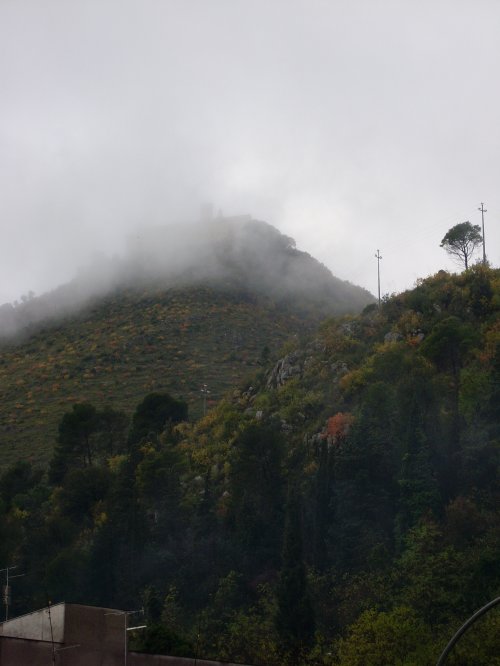
Throught the mist
The town of Cassino was bombed to rubble along with the Monastery and would have existed in name only. It is clear that this town has been rebuilt after 1945. A major loss of many beautiful old buildings I suspect.

Cassino before the bombing.
29th November 2008
Waited for bus (which didn’t arrive) to the Abbey. I kept looking up at it (the Abbey) and felt a strong compulsion to walk up almost like a pilgrimage. It is an 8km walk and very steep.
Fortunately as I began my walk, the weather cleared. The clouds blew away and revealed to me for the first time the Abbey, un-obscured by mist.
The walk was difficult but not impossible. I imagined soldiers in combat—trapped there for weeks on end in the cold and wet.
The mountain is covered in pines, ivy and many olive trees.
The road spirals around the mountain and each turns saw the Abbey slightly closer and becoming more real.
About half way up the Monastery bells begin to ring in the distance. A wonderful sound!
A few more turns and the Polish cemetery can be seen on the right. A beautiful location and a fitting resting place. The views are stupendous.
At this point I heard a strange whistling sound and soon realised that it was wind through the pines. An eerie and lonely sound that stopped as abruptly as it started.
There is a very fragrant smell coming from a small sweet conifer.
Finally reached the Abbey at 2.30pm and had to wait an hour before it opened. However, spending time looking of the mountains and valleys was worthwhile.
At 3.30pm the Abbey opened and it is like something out of Greek mythology. Statues, marble, porticos, gardens, columns —breathtaking.
The Basilica itself is extremely arresting. Very ornate and opulent.
I went under the main alter to St Benedict’s crypt which supposedly still contains his remains. This was one of the only areas undamaged by the bombing.
Shortly before 4pm I returned to the Basilica to hear the monks recite the afternoon vespers. These were preceded by the ringing of the bells. Very moving indeed. Simple antiphonal modal melodies. The natural reverberation of the Basilica is incredible—the sounds seems to hover in the air for ages.
This was the most moving experience of this visit and I was the only person besides the monks present in the Basilica on this day.