The Prodigal Child
The Prodigal Child - background
The idea to write a chamber opera based on themes of madness as a result of grievous loss; guilt and redemption was initially discussed in 1998 with poet and historian Alan Riach and the first version of this opera was completed in 1999.
Once the Opera was completed, it went into hibernation for 3 years and didn't surface until Creative New Zealand's ‘Wild Opera' - an initiative designed to lift the profile of New Zealand made opera.
As a result of the Wild Opera presentations, NBR New Zealand Opera decided to workshop the opera and after a number of edits etc ‘The Prodigal Child was ready for its first production and was premiered to critical acclaim at the 2003 Taranaki Festival.
Subsequently The Prodigal Child has been performed at four major festivals in New Zealand, 3 by NBR New Zealand Opera and one by an independent group in 2006 at the Hamilton Fuel Festival.
For a detailed synopsis see sleeve notes in CD.
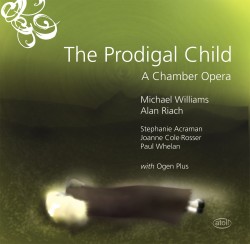
Purchase CD for only $9.95
This CD was completed in 2006 and commercially released through Atoll Records with the original cast members.
The Librettist
Alan Riach was born in Larnarkshire, Scotland and holds degrees from the Universities of Cambridge, where he studied English as an undergraduate, and Glasgow, where he completed his doctorate in the department of Scottish Literature. He worked in New Zealand from 1986 to December 2000.
Alan is a poet and was Associate Professor of English and a Pro-Dean of the Faculty of Arts and Social Sciences at the University of Waikato, New Zealand, where he specialised in twentieth century literature, teaching Scottish, Irish, American and post-colonial literatures and modern poetry.
His poetry has been published in numerous journals in Scotland, New Zealand and internationally. It is collected in "This Folding Map" (Auckland University Press/Oxford University Press, 1990) An Open Return (Untold books, New Zealand 1991) First and Last Songs (Auckland University Press / Chapman, Edinburgh, 1995) and Clearances (Hazard Press, NZ / Scottish Cultural Press, 2001). His radio series "The Good of the Arts" has been broadcast and repeated on Radio New Zealand's Concert FM programmes and can be visited at http://www.southwest.org.nz/productions/tgota/
Since 2003, Alan Riach has held a Professorship in Scottish Literature and is currently Head of Department. His most recent critical book is Representing Scotland in Literature, Popular Culture and Iconography: The Masks of the Modern Nation (Palgrave Macmillan, 2005).
Reviews
Below are excerpts from performance reviews of the Prodigal Child.
Newspaper Date & Performance Comments
New Zealand Herald March 2003 Taranaki Festival "The Prodigal Child" a mighty achievement for the festival and the opera company".
Sunday Star Times February 2003 "There probably parts of the opera that are a little Brittenesque, its not atonal at all, it doesn't always use diatonic scales but it generally has a tonal centre".
Theatre News February/March 2003 "The audience in New Plymouth was in a tense, concentrated silence throughout; there can be no doubt of the impact this drama and music made."
New Zealand Herald October 2003 "Remarkably for a new Zealand opera, where even a solitary production seems a miracle, Michael Williams' The Prodigal Child celebrated its third season in Auckland last night."
Christchurch Times July 2003 "It is an intimate, serious and moving work that grapples with deep and powerful themes, achieving much in its hour long duration."
Cast Requirements
There are three main characters, Albert, Mary and Anna. In the NBR New Zealand Opera performances they had the addition of the "spirit child" who participated in a number of scenes throughout the performance.
Albert (Baritone) is depicted as a man in his mid thirties, married (unhappily) to Mary (soprano) (tired, aged, around mid 30's). They run a local pub together, work very hard and have little in common. They would like children but are unable to have any and this has also had an affect on their marriage. Their struggles have left them bitter, loveless, poor and childless.
Anna (mezzo soprano) is a troubled, free spirited woman who lost a child at birth. The loss of the child has caused her to feel her life is meaningless and is spiralling through the depths of despair and madness as and yet has not come to terms with her loss.
Anna arrives at the pub, disoriented and dishevelled and looking for a place to stay after being lost and alone, cold and frightened. The discovery is then made that Anna was Albert's first love and the father of the stillborn child. Her arrival at the Inn brings the hidden secret to light and causes the characters to find a meaningful bond.
The Spirit Child was used in the NBR NZ Opera performances to enhance the story line (small female child, very fair, blonde, dressed in white) dancing lightly and fleetingly around the characters, sometimes touching or caressing them, just out of the vision of Albert or Anna.
The performance time of the Opera is 1 hour in total with no breaks. The rehearsals were held over a 4 day period and all performers were comfortable with the amount of time allocated and no major problems were encountered during the performances.
The Quintet
The Quintet is comprised of 2 violins, viola, cello and piano. It is recommended that the quintet be performed by professional chamber musicians. Although the individual parts are not overly difficult, the ensemble itself is complex and needs sensitive and refined playing.
Conductor
Ideally, to capture a true ‘chamber' spirit this opera would be best performed without a conductor. However, there are a number of tricky entries and difficult metres to negotiate. To date the opera has employed the services of a conductor and it is recommended that this person be a sensitive musician and unobtrusive director.
Set Designs
To date, The Prodigal Child has had two very different set designs, the production by NBR NZ Opera portrayed the story as being set around 1900 in a rugged, rural, setting in New Zealand. The other independent production was set around 1970. Both productions were set in rural New Zealand but can very easily be adapted to any country or era. Originally as written by the librettist, this Opera was set in rural Scotland.
The NBR NZ Opera set design was deliberately sparse which added to the austere character. The focus of the set is the bar itself, table, chairs etc with a slightly raked stage.
The independent production had two main set foci; a slightly overgrown garden with a large tree in the centre and the bar/ kitchen. The cost of this set was considerably more than the original production due to the cost of greenery.
Costumes
As the NBR NZ Opera's production was set around 1900 the costumes were of that period. Both females wore flowing dresses/skirts to the ankle, with lacy blouses, and heavy boots. Mary was portrayed to look more severe, highly strung and unhappy, with her hair in a tight bun and wearing an apron.
Anna is a very troubled woman, wearing looser fitting, more dishevelled clothing and her hair and make up looking quite unkempt and unorganised.
The "spirit child" was dressed in a white long lacy nightgown with long blond hair hanging loose.
Albert wore a period costume including lacy shirt and fitted trousers.
The independent production had 1970's costumes made especially for the Opera by a well known New Zealand fashion designer Anna Stretton
As the Opera itself is very versatile, the costumes can be designed to fit the ethnicity and era of your choice